
Clinical SAS Course – Complete Training Guide (2026)
Introduction
The Clinical SAS course has become one of the most important training programs for professionals who want to work in the pharmaceutical, biotechnology, and clinical research industries. As clinical trials generate large volumes of complex data, organizations depend on reliable and standardized tools to analyze results, maintain data integrity, and meet strict regulatory requirements. Clinical SAS plays a central role in this process by helping teams transform raw clinical data into accurate, compliant, and submission-ready outputs.

This Clinical SAS Course: Complete Real-Time Training Guide (2026) is created to help learners understand what Clinical SAS is, how it is used in real clinical projects, and what skills are actually taught in a structured training program. Whether you are a beginner exploring Clinical SAS for the first time or someone looking to understand the real-time training approach followed in the industry, this guide will walk you through the concepts, tools, workflows, and learning path required to build strong Clinical SAS knowledge.
taught in a structured training program offered by Dimensionality Software Services.
What Is SAS ?
SAS (Statistical Analysis System) is a comprehensive software platform used to manage, analyze, and interpret data. It provides a structured programming environment that allows users to work with large datasets, apply statistical techniques, and generate reliable outputs for decision-making.
The purpose of SAS in data analysis and reporting is to convert raw data into meaningful information. SAS is widely used for data cleaning, transformation, statistical analysis, and report generation. It enables analysts to produce consistent tables, summaries, and analytical results that can be easily reviewed, validated, and shared across teams.

SAS is trusted in regulated industries because of its accuracy, stability, and audit-ready design. It supports controlled processes, reproducible results, and strict data governance requirements. Industries such as healthcare, pharmaceuticals, finance, and government rely on SAS because it ensures data integrity, traceability, and compliance with regulatory standards enforced by authorities such as the FDA and EMA.
What Is Clinical SAS?
Clinical SAS is the application of SAS software specifically within the clinical research and pharmaceutical domains to manage, analyze, and report clinical trial data. It focuses on transforming raw clinical data into standardized, analysis-ready, and regulatory-compliant datasets that are required for evaluating the safety and efficacy of drugs and medical treatments.
The difference between general SAS and Clinical SAS lies in their purpose and context of use. General SAS is used across many industries for data analysis and reporting, whereas Clinical SAS is tailored to the clinical trial environment. Clinical SAS follows industry standards such as CDISC, supports clinical domain-specific datasets, and is aligned with regulatory submission requirements. It emphasizes data traceability, validation, and documentation, which are critical in clinical research but not always required in general analytics.
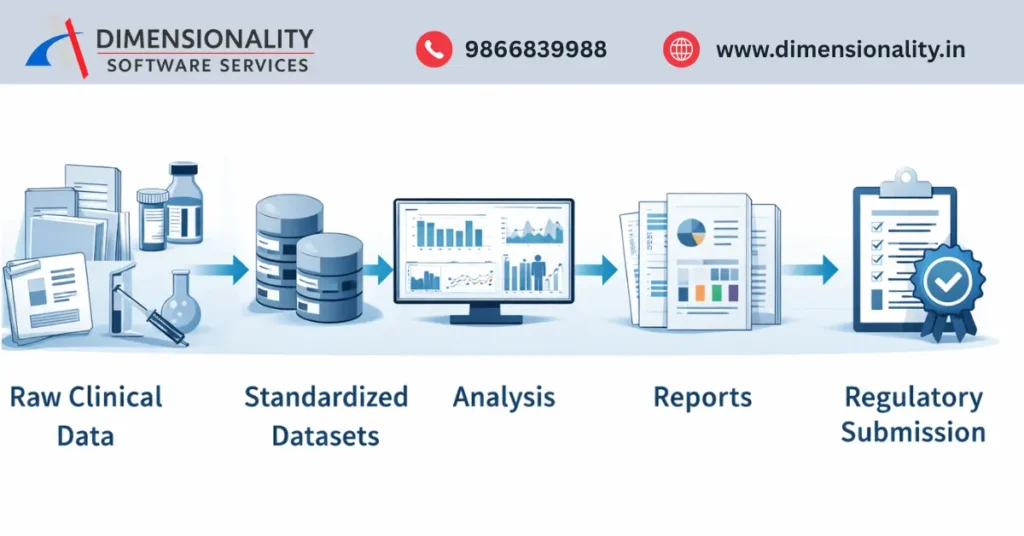
The role of Clinical SAS in the clinical trial lifecycle is central and continuous. Clinical SAS is used after data collection to clean and standardize trial data, create analysis datasets, support statistical evaluations, and generate regulatory deliverables. From early-phase studies to final submissions, Clinical SAS ensures that clinical trial data is accurate, consistent, and ready for review by regulatory authorities.
How Clinical SAS Is Used in Clinical Trials
Clinical SAS is applied throughout the clinical trial process to manage data flow from initial collection to final regulatory submission. Its use begins once trial data is collected and continues through analysis and reporting, ensuring consistency and compliance at every stage.
Clinical trial data flows across different study phases, from early development to late-stage trials. As studies progress, data volume and complexity increase, requiring structured processes to manage, integrate, and analyze information accurately. Clinical SAS supports this flow by organizing data in a controlled and traceable manner across all trial phases.
Raw data is collected from multiple sources during a clinical trial. These sources include electronic data capture systems, case report forms, laboratory results, vital signs, adverse event reports, and data from external vendors such as imaging or ECG providers. Clinical SAS consolidates these diverse datasets into a unified structure suitable for further processing and analysis.
The data standardization process is a critical step where raw clinical data is transformed into industry-standard formats. Using Clinical SAS, data is mapped to standardized models, validated for accuracy, and structured to support statistical analysis. This process ensures consistency across studies and allows results to be compared, reviewed, and reproduced.
Regulatory submission requirements demand high levels of accuracy, transparency, and compliance. Clinical SAS is used to prepare datasets, analysis outputs, and reports that meet regulatory standards. These deliverables support clinical study reports and enable regulatory authorities to review trial results with confidence, making Clinical SAS an essential component of the submission process.
Role of a Clinical SAS Programmer
A Clinical SAS programmer is responsible for converting clinical trial data into structured, analysis-ready formats that support statistical evaluation and regulatory reporting. Their work ensures that clinical data is accurate, consistent, and compliant with industry standards throughout the study lifecycle.
Day-to-day responsibilities of a Clinical SAS programmer include reviewing raw clinical data, performing data cleaning and validation, creating standardized datasets, and supporting the generation of analysis outputs. They write and maintain SAS programs to transform data, apply business rules, and produce tables, listings, and figures required for clinical reporting.
Clinical SAS programmers interact closely with clinical data managers to understand data collection methods, resolve data discrepancies, and ensure consistency between raw data and standardized datasets. This collaboration helps maintain data quality and ensures that changes or corrections are properly reflected across all datasets.

Collaboration with biostatisticians is another key aspect of the role. Clinical SAS programmers support statistical analysis by preparing analysis datasets, implementing statistical specifications, and generating outputs needed for interpretation. They work together to ensure that analyses are reproducible and aligned with the study objectives.
In regulatory and quality processes, Clinical SAS programmers play a critical role by maintaining traceability, following validation standards, and supporting audits or inspections. Their work helps ensure that datasets and reports meet regulatory expectations and can withstand review by quality and regulatory authorities.
Key Features of Clinical SAS in Real-Time Projects
Data Management in Clinical SAS
Data management is one of the most critical functions of Clinical SAS in real-time projects. Clinical trials generate data from multiple systems and sources, and this data must be handled in a structured, consistent, and compliant manner before it can be used for analysis.
Clinical SAS works with data collected from various sources, including electronic data capture (EDC) systems, case report forms (CRFs), laboratory data, and external vendors such as ECG, imaging, or central labs. These diverse datasets are integrated and aligned so that all clinical information follows a common structure and standard.
Data cleaning and validation are performed to ensure accuracy and reliability. This involves identifying missing values, inconsistencies, and outliers, and applying predefined rules to correct or flag issues. Clinical SAS programmers validate the data to confirm that it reflects what was collected during the study and is suitable for further analysis.
SDTM dataset creation is a core responsibility within Clinical SAS data management. Raw clinical data is mapped to standardized SDTM domains according to CDISC guidelines. This step ensures that the data follows industry-accepted structures and can be easily reviewed and understood by regulatory authorities.
Traceability and audit readiness are maintained throughout the data management process. Clinical SAS ensures that every value in the standardized and analysis datasets can be traced back to its original source. This traceability supports audits, inspections, and regulatory reviews, helping organizations demonstrate data integrity and compliance at every stage of the clinical trial.
Statistical Analysis in Clinical SAS
Statistical analysis is a central function of Clinical SAS and plays a critical role in evaluating the outcomes of clinical trials. Once clinical data has been standardized, Clinical SAS is used to support analyses that assess both the safety and effectiveness of a drug or treatment in a controlled and reliable manner.
Safety data analysis focuses on understanding the risks associated with a treatment. Clinical SAS is used to analyze adverse events, laboratory results, vital signs, and other safety-related parameters collected during the study. These analyses help identify patterns, trends, and potential safety concerns, ensuring that patient well-being is continuously monitored throughout the trial.
Efficacy data analysis is performed to determine whether a treatment produces the intended therapeutic effect. Using Clinical SAS, efficacy endpoints are analyzed based on the study design and statistical analysis plan. This process helps sponsors and researchers evaluate treatment outcomes objectively and supports data-driven conclusions about a drug’s effectiveness.
ADaM dataset preparation is a key step that enables accurate statistical analysis. Clinical SAS is used to create analysis-ready ADaM datasets that are derived from standardized SDTM data. These datasets follow predefined structures and rules, allowing statistical analyses to be performed consistently and reproducibly across studies.
Clinical SAS also provides essential support for biostatistical analysis. Programmers work closely with biostatisticians to implement analysis specifications, generate statistical outputs, and ensure that results are traceable and validated. This collaboration ensures that statistical findings are accurate, transparent, and suitable for inclusion in clinical study reports and regulatory submissions.

Tables, Listings, and Figures (TLFs)
Tables, Listings, and Figures, commonly referred to as TLFs, are essential outputs in clinical studies and form a core part of clinical trial reporting. Their primary purpose is to present clinical data in a clear, structured, and interpretable format that allows regulators, clinicians, and stakeholders to review study results efficiently and accurately.
Tables and listings are used to summarize and display detailed clinical information. Tables typically provide aggregated summaries such as demographics, baseline characteristics, safety outcomes, and efficacy results, while listings present subject-level data in a detailed, row-by-row format. Together, they allow reviewers to both understand overall trends and examine individual patient data when needed.
Graphical outputs play an important role in clinical reports by visually representing complex data. Clinical SAS is used to generate figures such as line plots, bar charts, box plots, scatter plots, and survival curves. These visualizations help highlight trends, comparisons, and key findings, making it easier to interpret results and support clinical conclusions.
Automation and standardization are critical aspects of TLF generation in Clinical SAS. Standardized programs and templates are used to ensure consistency across outputs within a study and across multiple studies. Automation reduces manual effort, minimizes errors, and ensures that TLFs follow sponsor-specific and regulatory standards, supporting efficient reporting and reliable regulatory submissions.
Machine Learning and Exploratory Analysis in Clinical SAS
Machine learning and exploratory analysis in Clinical SAS are primarily used to support early data understanding and decision-making rather than formal regulatory reporting. In clinical studies, exploratory data review helps teams examine emerging patterns, identify anomalies, and gain preliminary insights before confirmatory analyses are performed. Clinical SAS enables structured exploration of clinical data while maintaining consistency with clinical standards.
Exploratory data review allows clinical teams to assess data quality, trends, and distributions at different stages of a study. Using Clinical SAS, programmers and analysts can explore patient characteristics, safety signals, and outcome trends to better understand how data is behaving during the trial. This early visibility supports informed discussions among clinical, statistical, and operational teams.
Risk-based monitoring support is another important application of exploratory analysis in Clinical SAS. By examining trends and variations across study sites, subjects, or time points, teams can identify potential risks related to data quality, protocol deviations, or safety concerns. These insights help sponsors and CROs focus monitoring efforts where they are most needed, improving efficiency without compromising compliance.
Early-phase clinical insights are supported through exploratory and predictive techniques applied within Clinical SAS environments. During early-phase studies, these analyses help assess treatment responses, dose effects, and safety signals at an early stage. Although these insights are exploratory in nature, they play a valuable role in guiding study design decisions and supporting the overall clinical development strategy.
Integration and Enterprise-Level Support
Integration and enterprise-level support are essential aspects of Clinical SAS in large-scale clinical research environments. Clinical trials often involve complex systems, multiple stakeholders, and strict regulatory requirements, and Clinical SAS is designed to operate effectively within this enterprise framework.
CDISC standards implementation is a key component of this integration. Clinical SAS supports the application of CDISC standards such as SDTM and ADaM, ensuring that clinical data is structured, consistent, and compliant across studies. This standardization allows data to be shared, reviewed, and analyzed efficiently while meeting regulatory expectations for submission and review.
Multi-center and global study support is another critical capability of Clinical SAS. Clinical trials are frequently conducted across multiple sites and countries, generating data from diverse regions and systems. Clinical SAS helps manage and harmonize this data so that information from all study locations follows a common structure and can be analyzed collectively without loss of consistency or control.
Integration with databases and other tools enables Clinical SAS to function within broader clinical and enterprise ecosystems. It can work alongside clinical databases, data warehouses, and analytical tools, allowing seamless data exchange and processing. This integration supports efficient workflows and ensures that clinical data can move smoothly from collection through analysis and reporting.
Data security and compliance are fundamental requirements in clinical research, and Clinical SAS is built to support these needs. It provides controlled access, supports validation processes, and helps maintain data integrity throughout the trial lifecycle. By ensuring secure handling of sensitive clinical data and adherence to regulatory guidelines, Clinical SAS supports organizations in meeting compliance obligations while conducting reliable and trustworthy clinical studies.
Clinical SAS Course Curriculum (Training Focus)
The Clinical SAS course curriculum is designed to build strong foundational knowledge and gradually progress toward advanced, real-world clinical programming skills. The training focuses on practical understanding, industry standards, and workflows commonly followed in clinical research projects.
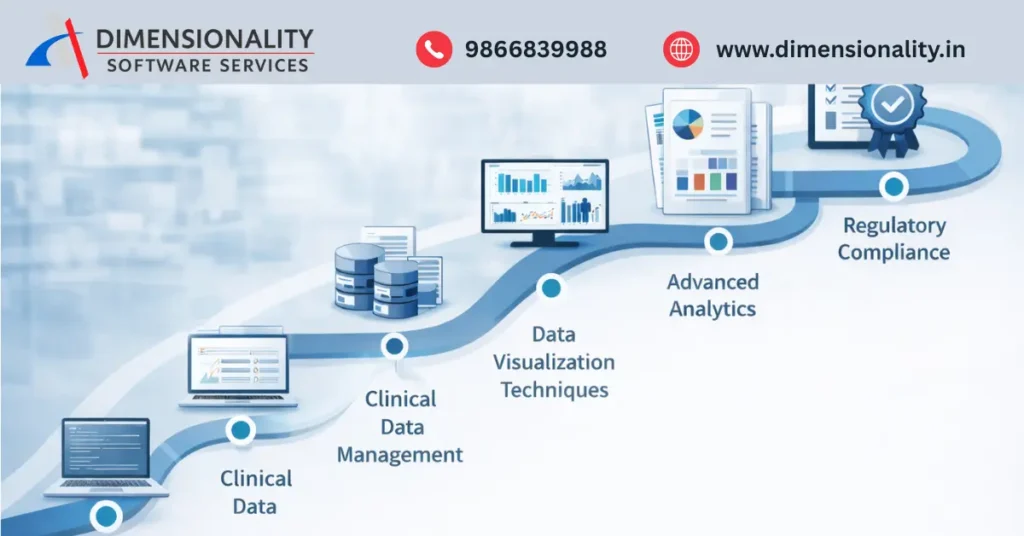
Fundamentals of SAS programming form the starting point of the curriculum. This stage introduces learners to the basics of SAS programming, including data step processing, procedures, and core programming concepts. It helps learners understand how to read, manipulate, and manage datasets, which is essential before moving into clinical-specific applications.
Advanced SAS concepts expand on the fundamentals and focus on more complex programming techniques. This includes working with advanced data manipulation methods, automation approaches, and efficient coding practices. These concepts prepare learners to handle larger datasets and more complex clinical programming requirements.
CDISC standards, specifically SDTM and ADaM, are a central part of Clinical SAS training. Learners are trained on how raw clinical data is mapped to standardized SDTM domains and how analysis-ready ADaM datasets are created. This part of the curriculum emphasizes regulatory expectations and the importance of consistency, traceability, and standardization in clinical trials.
Clinical data validation is introduced to ensure data accuracy and compliance. Training covers validation checks, comparison techniques, and review processes used to confirm that datasets and outputs meet predefined specifications. Learners understand how validation supports data integrity and regulatory readiness.
Reporting and documentation focus on the preparation of clinical outputs and supporting materials. This includes generating tables, listings, and figures, as well as maintaining clear documentation of programs, datasets, and processes. Proper reporting and documentation are essential for audits, reviews, and regulatory submissions.
Real-time project exposure is a key component of the curriculum. Learners work with practical examples and simulated clinical datasets that reflect real industry scenarios. This exposure helps bridge the gap between theoretical knowledge and actual clinical project work, enabling learners to apply skills confidently in professional clinical research environments.
Who Should Learn Clinical SAS Course?
The Clinical SAS course is suitable for individuals who want to build a career in clinical research and data analysis within regulated industries. The training is designed to accommodate learners from different academic and professional backgrounds, provided they are willing to develop both technical and domain-specific knowledge.
Life sciences graduates are a strong fit for Clinical SAS training because they already have exposure to biological and clinical concepts. Their understanding of subjects such as clinical research, biology, or related life science disciplines helps them grasp clinical trial processes and medical terminology more easily.
Pharmacy graduates are well suited for Clinical SAS due to their familiarity with drug development, pharmacology, and clinical studies. Clinical SAS training allows pharmacy professionals to apply their domain knowledge to data analysis and reporting, supporting drug safety and efficacy evaluation.
Statistics and mathematics students benefit from Clinical SAS training because of their analytical background. Their understanding of statistical concepts helps them adapt quickly to clinical data analysis and interpret study results accurately within a structured SAS programming environment.
Professionals from non-life science backgrounds can also learn Clinical SAS with proper training and effort. While they may need additional time to understand clinical terminology and trial concepts, structured Clinical SAS training helps bridge this gap by combining programming skills with essential clinical research knowledge.
Learning Path to Become a Clinical SAS Professional
The learning path to become a Clinical SAS professional begins with an entry-level approach that focuses on building core programming and data handling skills. At this stage, learners are introduced to SAS fundamentals and basic clinical concepts so they can understand how clinical data is structured and why accuracy and consistency are critical in clinical research environments.
Skill progression happens gradually as learners move from foundational knowledge to more advanced clinical applications. This stage involves working with standardized clinical datasets, understanding clinical trial workflows, and applying industry standards such as CDISC. As skills develop, learners become more comfortable handling complex data transformations, analysis-ready datasets, and clinical reporting requirements.
Hands-on project experience plays a vital role in this learning path. Practical exposure allows learners to apply theoretical knowledge to real-world scenarios that reflect actual clinical studies. Working on projects helps learners understand how data flows through a clinical trial, how challenges are addressed, and how outputs are generated in line with industry expectations.
Industry readiness preparation is the final stage of the learning path. At this point, learners focus on aligning their skills with professional clinical research practices, including documentation, validation awareness, and collaboration with cross-functional teams. This preparation helps ensure that learners are not only technically capable but also ready to work effectively within real clinical research environments.
Online vs Offline Clinical SAS Training
The online training approach offers flexibility and accessibility for learners who want to study Clinical SAS without geographical or time constraints. Online programs typically provide recorded sessions, live virtual classes, and digital learning resources that allow learners to progress at their own pace. This approach is suitable for working professionals or learners who prefer self-managed study schedules while gaining exposure to clinical concepts and programming practices.

Classroom training follows a traditional, in-person learning model where learners attend sessions at a physical location. This approach provides direct interaction with instructors, immediate clarification of doubts, and a structured learning environment. Classroom training is often preferred by learners who benefit from face-to-face guidance, peer interaction, and a fixed schedule that supports disciplined learning.
Hybrid training models combine elements of both online and classroom approaches. Learners may attend live sessions while also accessing recorded content and digital resources. This model offers a balance between flexibility and structured guidance, allowing learners to reinforce concepts through multiple learning formats while maintaining consistent engagement with instructors.
Choosing the right learning mode depends on individual learning preferences, availability, and professional commitments. Learners should consider factors such as time flexibility, need for instructor interaction, learning pace, and access to resources when deciding between online, classroom, or hybrid Clinical SAS training options.
Why Clinical SAS Skills Remain Relevant in 2026
Clinical SAS skills continue to be highly relevant in 2026 due to the strong regulatory dependency on SAS within the clinical research industry. Regulatory authorities across the world expect clinical trial data to be presented in standardized, well-documented, and traceable formats. Clinical SAS supports these expectations by enabling structured data processing and reliable reporting, making it a trusted tool for regulatory submissions.
Industry-wide acceptance of Clinical SAS further reinforces its relevance. Pharmaceutical companies, biotechnology firms, and contract research organizations consistently use Clinical SAS for managing and analyzing clinical trial data. Its widespread adoption across the industry ensures that professionals trained in Clinical SAS can work seamlessly within established clinical research workflows.
Long-term demand in clinical research also contributes to the continued importance of Clinical SAS skills. As clinical trials become more complex and data-driven, the need for professionals who can handle standardized datasets, support analysis, and generate compliant reports remains strong. Clinical SAS plays a central role in meeting these ongoing demands.
The stability of Clinical SAS as a skill is supported by its long-standing use in regulated environments and its proven reliability. While new technologies continue to emerge, Clinical SAS remains a core requirement for clinical data analysis and reporting. This stability makes Clinical SAS a dependable and future-oriented skill for professionals involved in clinical research and drug development.
Frequently Asked Questions (FAQs)
Conclusion
Clinical SAS training provides a strong foundation for understanding how clinical trial data is managed, analyzed, and reported within regulated research environments. Through structured training, learners gain practical knowledge of SAS programming, clinical data standards, and real-time workflows that are essential for working with clinical trial data in professional settings.
The importance of structured learning in Clinical SAS cannot be overstated. A well-designed training program helps learners progress from basic concepts to advanced clinical applications in a systematic manner. This approach ensures clarity, consistency, and a deeper understanding of industry standards and expectations, which are critical for success in clinical research roles.
For aspiring learners, Clinical SAS offers an opportunity to develop specialized skills that are widely used in the pharmaceutical and clinical research industries. With the right training focus and continuous practice, learners can build confidence in handling clinical data and prepare themselves to contribute effectively to real-world clinical research projects.